


 10.03.2026
  AICON
AICON 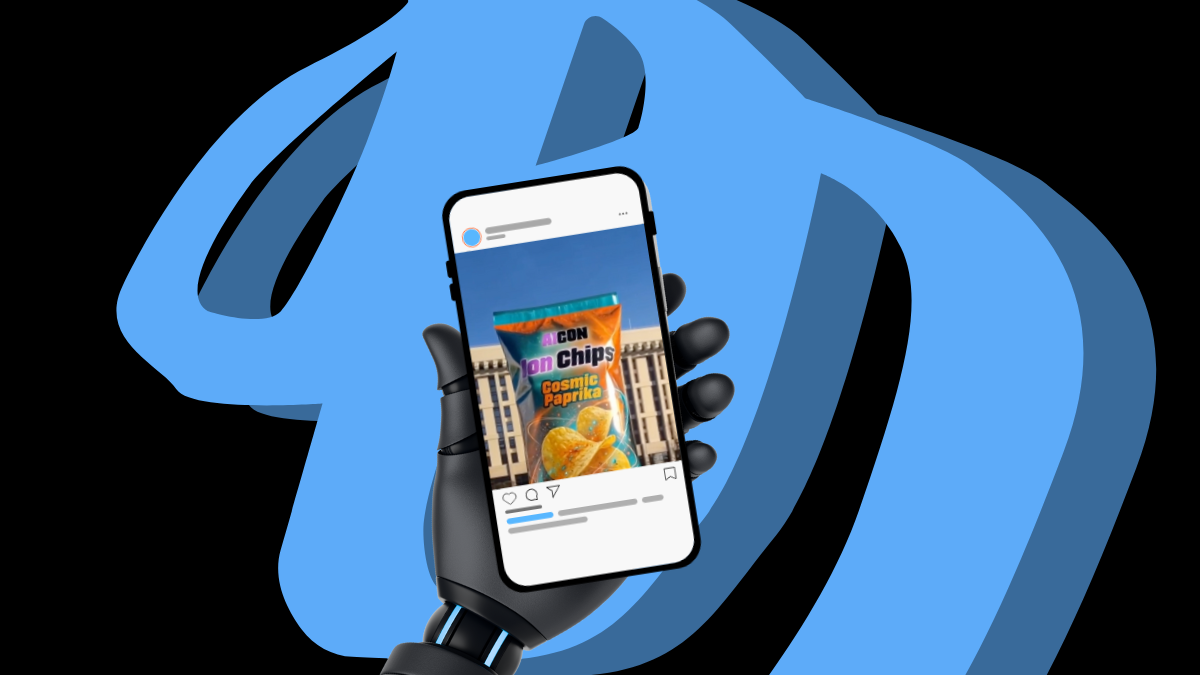
Until recently, FOOH was a toy for big brands, while others could only watch, envy, and say: “For now this is not relevant for us” (read: “We simply don’t have that kind of money”). But then AI stuck its artificial nose into this industry as well, and the expensive toy has now become an accessible tool.
Serhii Kolos, Chief Creative Officer of the AICON agency, explains why now any marketer can easily add FOOH to their strategy using AI and how to do it.
What FOOH Is and Why the Classic Format No Longer Works
You have definitely seen many videos on social media in which a brand’s product was organically integrated into a landscape: for Jacquemus these were bags driving through the streets of Paris, and for Netflix — a truck sniffing cocaine on city streets. These are examples of the FOOH technology — short videos where real locations are combined with digital 3D objects.
The key feature of such videos is that everything looks like a realistic “wow” effect. People in the videos actively film the event on their smartphones, as if they have become participants in a miracle. This magic was achieved thanks to VFX — realistic integration of 3D objects into video — which cost a lot of money, from 250,000 to 450,000 UAH. To do this, VFX specialists had to be hired for considerable fees, and the production process took one or two weeks. Therefore only brands with truly large budgets could create such a “wow” effect.
From our own experience we sadly watched how the marketing team’s eyes lit up while looking at references and scripts, and then instantly dimmed after seeing the price. At some point it became clear that most clients simply could not afford it, and it was better not to irritate them with such proposals at all.
So why does classic FOOH no longer work? Because people count money. Clients who could afford it already got their “wow” moment and are not planning to repeat it, while more budget-conscious brands no longer consider the format relevant because it has lost its novelty and value. AI visuals have significantly reduced that “wow” effect. So why pay more?
How AI “Killed” Expensive FOOH and Relaunched the Format
Then Kling AI appeared on the scene and released two new models: O1 and Motion Control. Without going into technical terms, in short this made it possible to capture moving elements in an input video, modify them, and integrate new elements into the video.
This means that any product can appear in any previously created video. And all of this can be done in minutes instead of weeks — and at a completely different price. In fact, the market now has the same tool but at a very low cost, and the list of performers has grown from 2–4 specialized FOOH production studios to hundreds of AI creators.
How AI Allows a New Product to Be Integrated into FOOH Without Reshooting
It should be noted that the tool is still quite new and not everyone understands its potential. In fact, right now we are slightly shooting ourselves in the foot: after seeing this opportunity, we are not keeping it as a know-how but instead saying to everyone, “Hey, look how this can work.”
As an example, we can mention a practical project in which we used an old FOOH case that our agency created with VFX for a Ukrainian brand at the beginning of 2025. Many backup takes remained from that project.
We started with the simplest thing — we invented AICON ionized chips and placed the product in the video. Everything worked: cars moved, people moved, and the package stood exactly where we wanted. Then we started experimenting with the environment: adding snow, summer scenes, turning everything into Legoland, and eventually placing robots in the scene (we predict AI development will eventually reach that point). Everything worked exactly as in classic FOOH, but with one difference — it was very fast and much cheaper.
What FOOH Is and Why the Classic Format No Longer Works
Come to the contractor with your own original video. In it you should think about how the camera will move, what reactions “random passers-by” should have in the frame, and where there will be space for the product.
Among contractors you should look for those who understand both AI and filming video with a camera or smartphone. This will not be a 100% replacement when the video is one continuous take, because neural networks do not always give perfect results. However, if the contractor understands editing, this problem can be solved.
Consider all legal aspects. Remember: everything that appears in the frame may have copyright and legal consequences. But if you have a legal department, they will tell you about this anyway.
Conclusion
In the end, we have the following: FOOH — or rather AI-FOOH — has stopped being an expensive tool reserved for large players and can gain new life thanks to the involvement of small and medium-sized brands. Instead of a week of work — one working day, and instead of astronomical costs — a fairly reasonable price. And when our colleagues see this text, competition will push the price even lower.
Because the real rocket science here is seeing how an AI tool can work for a brand. And we have just shown you how. Therefore marketing teams should reconsider their SMM plans and the potential of AI-FOOH within them — because the wow effect no longer costs a huge amount of money or time.